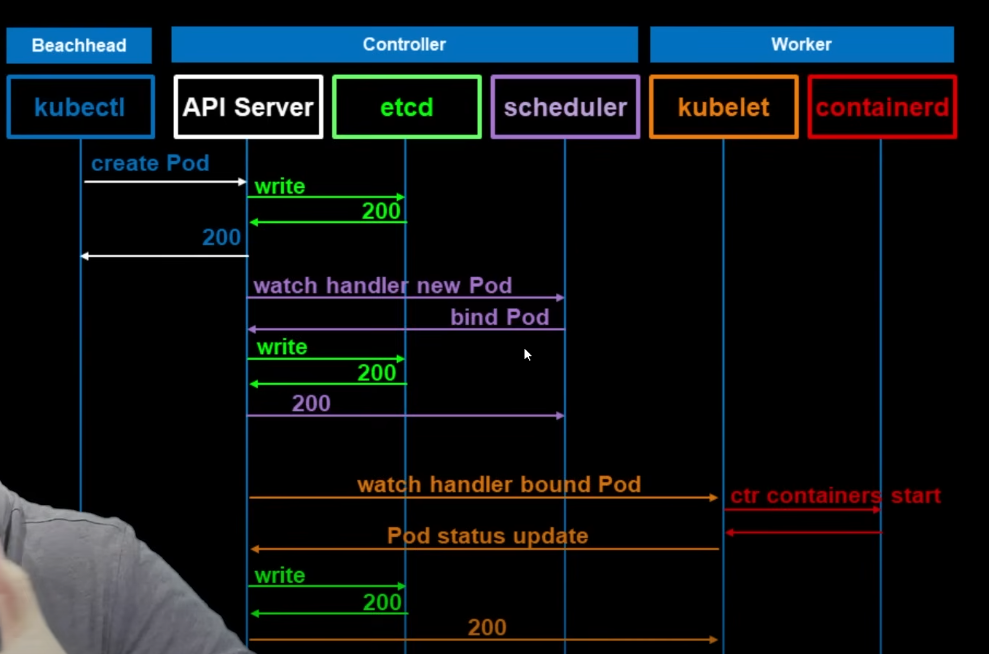
It needs one master node, and each worker node will have a “kubelet” process, which makes it possible for clusters to talk with each other and execute tasks. Kube-proxy is for maintaining network rules in each node
Control Plane
It mainly runs an API server, which is also a container. It is the entry point to the cluster, which different K8s clients will talk to like UI, scripts, and CLI. You can use Kubectl to talk with it.
Other is Controller Manager, which keeps an overview in the cluster, like repairs, replacements, restarts, namespaces etc.
Another one is Scheduler, which is responsible for scheduling containers on different nodes based on workload. It decides where to put the Pod to.
Another one is etcd, which is a key-value storage which anytime holds the current state of the Kubernetes cluster. It keeps config data, status data of each node and container. Backup and is also made from etcd
The most crucial maintenance tasks is backing up etcd. If etcd is lost, the cluster is lost
Deployment
Deployments are blueprints for replicas, pods, etc. It is an abstraction of Pods.
- You mostly work with deployments, not Pods
Warning
DB can’t be replicated via deployment!
To replicate DBs, you use StatefulSet.
- Deployment = for stateless apps
- StatefulSet = for stateful apps or databases
Creating a Pod