It is a bridge between on-premises data and cloud data
Use cases:
- disaster recovery
- backup & restore
- tiered storage
- on-premises cache & low-latency files access
Types of Storage Gateway:
- S3 File Gateway
- Volume Gateway
- Tape Gateway
S3 File Gateway
Used for non-glacier S3 buckets
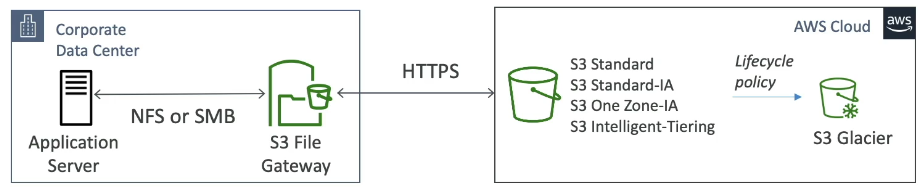
Configured S3 buckets are accessible using NFS and SMB protocol. You connect to S3 File Gateway, and it connects to the backend S3 bucket via HTTPS.
- Most recently used data is cached in the file gateway
- Doesn’t support Glacier, but you can use Lifecycle Policy
- Gateway uses IAM to access S3
- SMB has integration with AD
Volume Gateway
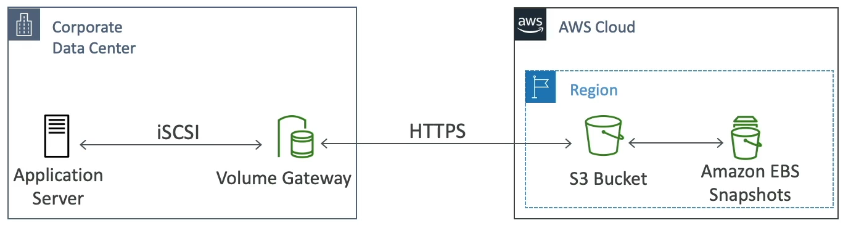
Block storage using iSCSI backed by S3.
- Backed by EBS snapshots which can help restore on-premises volumes
- Cached volumes: low latency access to most recent data, data stored in S3 and cache is on-prem
- Stored volumes: entire dataset is on premise, scheduled backups to S3 with EBS Snapshots
Tape Gateway
Used for physical tape backup. Same process, but in cloud
- Virtual Tape Library (VTL) backed to S3 and Glacier, back up using existing tape-based process and iSCSI interface